
00. Introduction
Richardson-Bates House Museum
Transcript
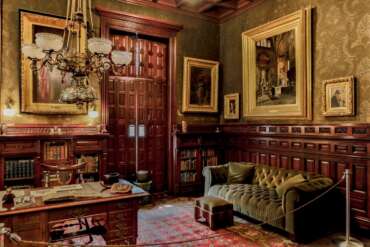
Situated on Oswego’s historic east side, the Richardson-Bates House Museum invites visitors to step into an authentic Victorian-era mansion steeped in local history. Built in two stages, beginning in 1867 and completed in 1889, this elegant home served as the private residence of Maxwell B. Richardson, a respected attorney, real estate broker, and two-term mayor of Oswego. A lifelong bachelor, Max shared the mansion with his widowed mother, Naomi Bennett Richardson, his divorced sister, Harriet Richardson Bates, and her son, Norman.
The Richardson and Bates families were deeply involved in Oswego’s cultural life. Max opened the 1400 seat Richardson Theatre on East Second Street in 1895, showcasing the top theatrical talent of the day, such as Ethel Barrymore and John Philip Sousa. In 1896, Max was one of the original members of the Oswego County Historical Society, while Norman served as its secretary. Later, Norman’s wife, Florence Morley Bates, became one of the first women admitted to the Historical Society, underscoring the family’s commitment to preserving local heritage.
Naomi lived until 1890; Max passed away in 1903, and five years later, Harriet followed. The house was willed to Lawrence Richardson, Max’s younger brother, who, in turn, made Norman his heir. In 1910, after Lawrence’s death, Norman moved back to the home and lived there with Florence, their four children Betty, Norman Jr., Sally, and Maxwell, and at least two live-in servants. Beyond managing the family estate, Norman continued his involvement in his uncle’s real estate and insurance ventures, directed the Oswego Chamber of Commerce, and served as president of the Oswego Country Club. A pioneer in photography, Norman embraced the emerging camera technology and captured numerous images of the completed house in 1889, a visual legacy now exhibited at the museum. When Norman died in 1923, he left his estate to his formidable wife, Florence.
Florence was a dedicated benefactor to Oswego’s charitable causes. In 1944, she was instrumental in organizing an open house at the Emergency Refugee Shelter at Fort Ontario, which provided a temporary safe haven for nearly 1000 European Holocaust survivors. This event played a crucial role in dispelling rumors that the refugees were living in luxury while the local community faced wartime rationing and scarcity.
After Florence’s death in 1945, her three surviving children generously donated the house, along with 90% of its furnishings and personal collections, to the Historical Society. Their legacy now lives on through this museum, which also serves as the Historical Society’s headquarters.